| Cowell's Beach with Teva, Surfrider & Save The Waves |
Tuesday, November 20, 2012
Post Film Fest: Santa Cruz Beach Clean Up
Thursday, November 8, 2012
Join Us this Saturday - Beach Clean Up
![]() |
| Beach Clean Up - this Saturday morning in Santa Cruz |
Monday, October 22, 2012
Save The Waves Film Festival Tour
![]() |
| savethewaves.org/filmfestival |
Early Bird Wave Saver Tickets: Admission tickets to our shows in Santa Cruz (Nov 9) and San Francisco (Nov 16) are discounted "Early Bird Wave Saver Tickets" -- only until October 31 -- so get your tickets now. These events will sell out, get your tickets early and often: savethewaves.org/filmfestival
Wednesday, October 3, 2012
Santa Cruz Rally
Where: Mitchell's Cove, Santa Cruz, California.
When: 3PM, Sunday, October 7, 2012.
What: Rally for the Right to Vote on Desalination.
Ken “Skindog” Collins, local big wave surfer and Santa Cruz World Surfing Reserve Surfing Ambassador, says, “Santa Cruz does not need a Desal Plant right now. What Santa Cruz does need right now is the people of the community to step up, get involved, and protect the natural resources that we are truly blessed with, and want to continue to have for our children and generations beyond.”
Jim Littlefield, from Surfers’ Environmental Alliance (SEA), agrees: “SEA absolutely supports the right of Santa Cruz voters to ultimately decide whether or not to invest in such a massive construction plan when previous desalinization projects around our country have such a dismal success record.”
Background information: "Right To Vote on Desal" - Santa Cruz Wiki.
Wednesday, September 12, 2012
Be a Hugger of Waves
Purchase our Wave Hugger T-Shirt and support the protection of our coastal heritage. This T-Shirt is only available online at Save The Waves Store. Available in Men's and Women's style:
www.savethewaves.org/store
Thursday, August 16, 2012
Maldives Epic Surf: Privatized Soon?
Maldive surfers are organizing around a potential threat to surf access on Thamburudhoo Island, home to two of the area's best surf spots in the Maldives.
Tuesday, August 7, 2012
Martin's Beach - CLOSED
Located just off of California's scenic Highway One near Half Moon Bay, Martin's Beach is a small enclave of unique coastal access for local surfers, picnickers and other beachgoers. On a stretch of uninhabited coastline where there are limited ocean access options, Martin's Beach is a historic gateway to sand, surf and ocean for those in the know.
Since 2008, a new owner has blocked access to Martin's Beach by locking the gate on the road that leads to the oceanfront beach. Previously, the public was granted access for a small entrance fee.
According to the California Coastal Act and historic precedent, in cases where the public has had continuous access to the coast through private property, the state can enforce the preservation of that access. (A San Jose Mercury News article here details this issue and features the owner's lawyer's comments.)
![]() | |
| Art on the billboard at Martin's Beach protested its closure. Video below. |
Local residents are organizing weekly protests at the gate to Martin's Beach. You can learn more and support this cause at the Open Martin's Beach Facebook page.
In late 2010, graffiti artists protested Martin's Beach closure with billboard art at the entrance to Martin's Beach on Highway One, an act of defiance which was immediately painted over by the property owners:
Tuesday, July 17, 2012
We Exist to Oppose This
![]() |
Wednesday, July 11, 2012
An Invitation
From the perspective of those who experience it, the purpose it serves, the feelings it evokes. How it looks, sounds, and moves. How it behaves. How it awes, and inspires, and delights us. How it holds the power to utterly transform us.
Let’s give voice to the reasons waves are special, treasured, cherished, adored. Let’s explain why they’re vital. The truths about why we worship at their altar.
Let's explore this elemental, fundamental part of our lives. A reflection of unexpected, surprising, taken-for-granted truths about the simple, awesome thing that is a wave.
We want to speak from the perspective of surfers and non-surfers alike. From that of naturalists, conservationists, and environmentalists. From nature-lovers and ocean-lovers. From young and old. Scaled and finned. From all over the oceans, all around the globe.
Let’s capture the inexpressible, magical power of the wave, and touch, in everyone, the place where these sentiments reside.
![]() |
| An Invitation (Watch the PSA video here) |
Let’s show them just how to help keep waves protected, for now and for the future. At savethewaves.org
Thursday, January 12, 2012
New Fuerza Chile! Posters
Check out these new rad posters by Dominick Frabizio. The artwork is cool, pulp mill pollution is not. Follow the links below for more creative works by Dominick.
www.brownstchronicles.blogspot.com
www.dominickfrabizio.blogspot.com
Click here to see how you can get involved to protect the coast and ocean in Chile.
Tuesday, January 10, 2012
Update on Sandbags at Sloat
The City of San Francisco has recently obtained an emergency permit from the CA Coastal Commission to place sandbags along the shoreline of the Sloat region of Ocean Beach. This permit is intended to protect the Great Highway and Lake Merced Tunnel from potentially significant bluff retreat during the winter storm season. As seen throughout the last decade, storms can cause major bluff retreat at Ocean Beach and impacts infrastructure built too close to the coast, such as the Great Highway and Lake Merced Tunnel.
Unlike in previous years, however, San Francisco has opted to implement a relatively softer bluff protection measure. Sandbags are flexible, easily installed and easily removed, and do not have the same destructive impacts as rock and concrete revetments.
According to the design report, the Great Highway and Lake Merced tunnel will be temporarily protected from winter storm events by large sandbags that will be placed along the bluff toe and slope. Approximately 375 tan-colored, geo-textile sandbags will be used as bluff protection. The bags would be deposited in a 4-foot-wide by 70-feet long toe trench that would be excavated to a depth sufficient for 2 bags to be embedded.
While sandbags are indeed a step in the right direction from the destructive armoring strategies that the City has implemented in the past, it is important to urge San Francisco officials to move away from coastal armoring altogether and to adopt strategic relocation (a.k.a managed retreat), which is a more sustainable bluff protection and erosion control strategy.
Click here to watch a video of the sandbag placement, courtesy of Tom Prete/Ocean Beach Bulletin.
Here are photos taken in early January of the work:
Photos: Save The Waves Coalition
Tuesday, November 8, 2011
Save The Waves Film Festival Goes Off!

Save The Waves Coalition thanks the presenting sponsors of Save The Waves Film Festival for their generous support of this non-profit fundraiser: Clif Bar, Rip Curl, Jim Beam and Patagonia.
A collection of locally made short films launched the evening's film festival after a welcome set of surf-drenched reggae by My Peoples: Surf for Life explored the philanthropic possibilities of grassroots surf tourism; Soundings celebrated the activist nature of surfers and ocean lovers; Great Highway celebrated the first surfers of San Francisco; and Save Sloat recounted the problems and solutions at the southern edge of San Francisco's Ocean Beach where the road, parking lots and city infrastructure are falling into the ocean.
Other notable happenings during Save The Waves Film Festival include an exclusive, on-stage interview with pro surfer Dusty Payne -- unfortunately cut short by a shark sighting; a very special wooden bodysurfing wetsuit handmade by local shaper Danny Hess; and a celebrity sighting of Giants relief pitcher Brian Wilson who was there to introduce his fellow bearded warrior, filmmaker Keith Malloy.
The night ended with legendary bodysurfers Mark Cunningham and Keith Malloy taking the stage to present their new film, Come Hell or High Water. The film was a resounding yet unlikely success due to its non comformist bodysurfing subject matter, and the crowd was elated. Over ten thousand dollars were raised for Save The Waves Coalition's campaign to Save Sloat and the World Surfing Reserves program.
Save The Waves Film Festival was also proudly supported by: 7x7 Magazine, Hog Island Oyster Company, Zola Acai, Pacifico, Peligroso Tequila, Ocean Vodka, My Peoples, San Franpsycho and Transworld Surf. More information about the film festival and the programs it supports can be found at www.savethewaves.org/filmfestival


Friday, October 28, 2011
The Skinny on the OB Lawsuit Against the City of SF

by Stephanie Haughey, Save The Waves Intern
On August 9, 2011, the California Coastal Protection Network (CCPN) filed suit against the City and County of San Francisco. CCPN argued that the City violated the California Coastal Act by failing to obtain a coastal development permit for development undertaken at Ocean Beach San Francisco.
The Coastal Act requires that anyone wishing to undertake development located within the coastal zone must obtain a coastal development permit. The coastal zone is an area that generally extends inland 1,000 yards from the mean high tide line of the sea, and the Coastal Act provides a broad definition of what actions constitute “development.” Among other requirements, the permit applicant must describe the proposed development project and its intended uses, describe ecological characteristics of the proposed location, and include feasible alternatives or mitigation measures which would substantially lessen any significant adverse impacts. After reviewing the application and considering public comments, staff reports and oral presentations, the California Coastal Commission ultimately determines if the proposed development should go forward. This process ensures a careful assessment of the proposed development’s impacts on the environment.
CCPN alleged in its complaint that the City violated the Coastal Act in the following way:
- The City failed to obtain a coastal development permit for the construction of a 600-foot-long rock revetment on Ocean Beach San Francisco between Sloat and Skyline Boulevard on or about the year 1997.
- While the quarry revetment was supposedly temporary and put in place only under emergency conditions in response to erosion damage from El Niño storm events, CCPN believes the City has dumped rocks, concrete sidewalk, pavement, rebar, metal poles and other rubbish onto the beach since 1997 without permits from the Coastal Commission. The Ocean Beach-Great Highway Storm Drainage Protection Project Final Report (May 2005) supports this allegation. The report stated that the 1997 revetment, “does not meet coastal engineering design standards” and would “experience a faster rate of degradation than an engineered structure and will require maintenance….” As the erosion continued and the revetment became less effective for protecting the bluff, it would be reasonable to believe other measures were taken to protect the beach, such as continuing to dump debris, with or without the proper authorization
- The City experimented with another strategy to curtail the effects of erosion: dredging sand from the Golden Gate shipping channel and dumping it into shallow waters on Ocean Beach from 2006 and continuing until the present without permits from the Coastal Commission. Without the necessary authorization, this action is illegal, as well as potentially destructive to marine ecosystems of Ocean Beach.
- The City was out of compliance with several conditions attached to Emergency Permit 2-10-003-G, including the finalized length of the revetment being 15 linear feet longer than what was approved in the emergency permit (the revetment was 440 linear feet, not the approved length of 425 linear feet). Additionally, the City failed to submit a complete application for a coastal development permit by the specified deadline in 2010.
Coastal erosion is a serious concern and will only worsen as climate change increases wave intensity. However, creating a wall of rubbish and debris to deflect impending sea level rise and erosion has proven to be ineffective and costly. The Ocean Beach-Great Highway Storm Drainage Protection Project (2005) even conceded that the 1997 revetment was inadequate because erosion was observed above the revetment due to wave run-up and windblown spray. Yet, the City of San Francisco has continued to use coastal armoring as its quick fix to erosion and has ignored arguments made by environmental groups, university professors, scientists and San Francisco residents for the implementation of a managed retreat and strategic relocation approach to erosion.
WHAT THE FUTURE HOLDS
Apart from its involvement in the CCPN lawsuit, the City may:
- Apply for another emergency permit in response to erosion damage from weather-related events in the winter months. Given the uncooperative nature of the City, the Commission may be reluctant to grant an emergency permit that permits the implementation of the destructive and ineffective coastal armoring method to erosion control previously used by the City.
- Resubmit an application for a coastal development permit for its development at Ocean Beach. The City’s preferred method of erosion control is obvious: coastal armoring. One may argue that it is unlikely that the Commission would change its mind on the issue and approve an application that is substantially the same development as the City’s previous application (rock revetment). Instead, the Commission may welcome an application that incorporates sustainable erosion control measures such as managed retreat (strategic relocation).
For more information on the Save The Waves' campaign to Save Sloat! and ways that you can take action, please visit www.savethewaves.org/save-sloat. To sign the petition to Save Sloat!, please visit http://www.thepetitionsite.com/takeaction/220/377/665/.
Wednesday, October 19, 2011
Come Hell or High Water on November 4

Keith Malloy’s directorial debut surf film, Come Hell or High Water, will premiere in San Francisco on Friday, November 4 at Save The Waves Film Festival. Tickets to Save The Waves Film Festival are now available for purchase online at www.savethewaves.org/filmfestival - be sure to get your tickets now.
Californian Keith Malloy of the Malloy clan steps out for his debut feature film in this unique exploration of bodysurfing. This is perhaps the greatest surfing film ever made, and not a single surfboard appears in it. Nearly anyone who has been in the ocean has bodysurfed, and the film appreciates these humble roots while also celebrating the dedicated characters who devote their lives to bodysurfing.
Save The Waves Film Festival is a non-profit fundraiser and all proceeds benefit the local Save Sloat and World Surfing Reserves programs of Save The Waves Coalition. This is a one-night, cutting-edge film festival event featuring documentary surf films, activists, athletes and artists who champion the human and environmental elements of surfing and ocean conservation.
Other films at Save The Waves Film Festival include a director’s cut of “Another Day in the Life of Wayne Lynch” by Cyrus Sutton, and a special short cut of “Great Highway” about the legendary surfing history of San Francisco’s Ocean Beach.
Save The Waves Film Festival is proudly presented by Clif Bar, Patagonia, Jim Beam, and the Rip Curl Pro Search “Somewhere in San Francisco.”
Save The Waves Film Festival is also supported by Zola Acai, Pacifico, Hog Island Oyster Company, 7x7 Magazine, Ocean Vodka, Peligroso Tequila, My Peoples, TransWorld Surf, and San Franpsycho.
Get your tickets now! This event is 21 and over only, please bring identification to be checked at the door. Ticketing and all event details can be found at www.savethewaves.org/filmfestival
Friday, August 19, 2011
The future of Ocean Beach: dangerous debris piles or natural sandy beach?
Opinion By Mark Massara
What do we want the southern part of Ocean Beach to be like in the future? Do we want an industrialized beach cluttered with chunks of broken sidewalks and old pavement, or do we want a place where careful management allows for surfing, fishing or simply walking along the shore? It’s time to choose.
The California Coastal Commission recently struck an important blow in the struggle over the future of Ocean Beach by rejecting an unwise and ineffective plan to dump more rubble onto the sandy beach in an ultimately counterproductive attempt to protect nearby wastewater infrastructure.
But as significant as it is, the commission’s decision is just one piece of a complex, long-term process of choosing a path for an area of precious coastline where for more than 15 years San Francisco City bureaucrats have dumped rocks, sidewalk and pavement debris, rebar, poles, and other assorted junk and rubbish onto the beach and into the Golden Gate National Recreation Area with astonishing regularity and commitment.
Coastal Commission rebukes San Francisco
In July the California Coastal Commission unanimously denied a formal request by San Francisco to leave in place the debris it has strewn across Ocean Beach from Sloat Boulevard south to the Oceanside Water Pollution Control Plant, including hundreds of feet of rock revetments built without permits in 1997, and the commission also refused the City’s request to add even more rubble and two retaining walls.
The Coastal Commission is tasked with upholding the California Coastal Act, the landmark coastal-protection initiative passed in 1972 by voters. The act is designed to protect coastal resources and public access to beaches.
The entire Coastal Commission staff analysis, including vivid photographs, is available online. Photographs over the past 50 years are available at the California Coastal Records Project, and the San Francisco Surfrider Foundation maintains a blog regarding the situation.
To put the matter in context, the entire area, which now resembles a third-world war zone, is actually a national park — part of the Golden Gate National Recreation Area. Imagine if the City of Merced suddenly concluded that the Merced River through Yosemite Valley posed a danger, and tried a stunt like dumping old sidewalks and rebar in Yosemite Park.
The Coastal Commission ruled the situation untenable and the City’s strategy, or lack thereof, unacceptable. As the hearing unfolded, commissioners were astonished that instead of a long-term plan to deal with continuing erosion, the City was instead asking for permission to continue to dump junk onto the beach.
During the hearing the City took the position that “vital infrastructure” is threatened and must be protected. What wasn’t clear, though, is what the City considers “vital” and at what point it is considered “threatened.”
For example, the restroom at the Sloat Boulevard parking lot and the roadway could easily be moved to provide for managed retreat and bluff restoration. Restored bluffs are the best defense for a rising ocean. In fact, the National Park Service, in their letter to the Coastal Commission regarding the Sloat situation, said it believes the rock revetments constructed by the City are actually exacerbating erosion in the area. This would confirm what experts have long known — that sea walls and shoreline armoring don’t stop erosion, they make it worse.
Coastal Commission members took umbrage at San Francisco’s use of trash to stop erosion, a technique long ago discredited in California. Commissioner Brian Brennan from Ventura pointed to a successful program of rock removal and shoreline retreat and restoration at the Ventura Fairgrounds in Southern California.
Commissioner Mark Stone of Santa Cruz County referred to a project in which his county spent many millions of dollars along East Cliff Drive at Pleasure Point to construct a vertical seawall. In contrast to San Francisco’s proposal, that seawall visually matches the existing bluff, and includes formal stairways, emergency-escape goat trails, view benches, parks, restrooms, and hiking and biking trails.
Other commissioners concurred that the type of debris dumping San Francisco has engaged in would never be permitted in any other California coastal community. The fact that the City claims on its website to be the “Greenest City in North America” just adds insult to the abuse done at Ocean Beach.
In legal terms, all the debris is now illegal. The illegality is ironic inasmuch the San Francisco Board of Supervisors basically ordered the Department of Public Works to stop dumping rocks, remove old debris and do long term planning for the Sloat area way back in 1999 [EDITOR'S NOTE: City and County of San Francisco, Board of Supervisors, Resolution 698-99, File 991163, Resolution on Ocean Beach and Great Highway Emergency Authorization. July 30, 1999]. Yet DPW, for reasons not clear, ignored Mayor Willie Brown and the Board of Supervisors, and has continued to run amok and make a mess of the area since.
What happens next is that the City will be given an opportunity to remove the offending debris and rocks. Should San Francisco continue to ignore the Coastal Act they will be subject to fines and penalties of up to $15,000 per day. Based upon DPW’s past actions and continuing reliance on lobbyists urging more dumping of rocks and rubbish, tens of millions of dollars in civil fines and penalties are a distinct possibility.
What does the future hold for Ocean Beach?
Fortunately, in addition to the 1999 Board of Supervisors resolution, there is an ongoing master-plan effort for Ocean Beach that will be concluded around the end of the year. In public meetings thus far, activists and the National Park Service have shown overwhelming support for the protection of natural resources at Ocean Beach. This was the case in 1999, and this sentiment has been present in the work of Friends of Ocean Beach and the Ocean Beach Task Force as well as every other public participation process ever convened regarding management of the beach. As far as the record stands, the only organization to ever support throwing trash and junk onto the beach is DPW.
Further, genuine long-term planning and strategic-retreat analysis are clearly needed and necessary. Yet despite requests from the Board of Supervisors and the Coastal Commission, DPW has steadfastly refused to engage in future planning. Based upon the most reliable scientific analysis available, seas are expected to rise approximately 4.5 feet over the next 80 years, a dramatic increase over the 9-inch rise over the past century. If such forecasts prove to be accurate, much of the beach and oceanside development in San Francisco will be drowned, creating an urgent need for adaptive and resilient planning now.
One view of the situation at Ocean Beach is that if future armoring is needed south of Sloat, it should be limited to the Oceanside water-treatment facility, meaning that DPW should plan now to move beach amenities, sewage connector pipes, and the roadway. None of it needs to happen tomorrow. It could be planned in phases over many decades. And future armoring of the water-treatment facility should coincide with tidal reconnection of the ocean with the northern portion of Lake Merced, to provide a safety relief valve wherein ocean energy can be directed into part of Lake Merced, either by pipeline or an open ocean inlet.
For those who care about the future of Ocean Beach, now is the time to join the Coastal Commission in rebuking DPW and its insistence on continuing to dump debris in a national park. For without your voice, and the continued watchdog efforts and legal fines and penalties, DPW is unlikely to change course in future years.
Mark Massara is a longtime Ocean Beach resident and an environmental lawyer specializing in coastal resource protection.
Friday, July 1, 2011
Help Stop the Permit for More Armoring at OB!
Inner Bar Surf at South Sloat - Threatened By Backwash
Heads up friends,
The California Coastal Commission is set to have a vote on SFDPW's permit application to expand armoring at Sloat Boulevard.
The meeting will be on Wednesday July 13, at Marin County Board of Supervisors 3501 Civic Center Drive Rm 330 San Rafael starting at 9am.
This is the set of permits that goes way beyond the work needed to finish last year's emergency repairs. We have already sent in well over 100 letters from our supporters, as well as spoke directly with the Commission about this issue.
Our main point remains that permitting the expansion of armoring is unnecessary, and will only serve to undermine a primary goal of the SPUR Ocean Beach Master Plan process. That objective is to create a long term plan for Ocean Beach erosion shaped by all stakeholders - public, government, and non-profits.
Please come on down to comment in person if you can. If not, you are always welcome to send letters directly to the Commission. They don't allow email, so please print out your letters and send them via traditional mail: Here's the contact info.
North Central Coast District Office
Charles Lester, Senior Deputy Director
Ruby Pap, District Supervisor
45 Fremont Street, Suite 2000
San Francisco, CA 94105-2219
(415) 904-5260 or
(415) 904-5200
FAX (415) 904-5400
Click this link for the meeting agenda.
Thanks!
Blog posting originally posted by Bill McLaughlin of Surfrider SF.
Wednesday, June 29, 2011
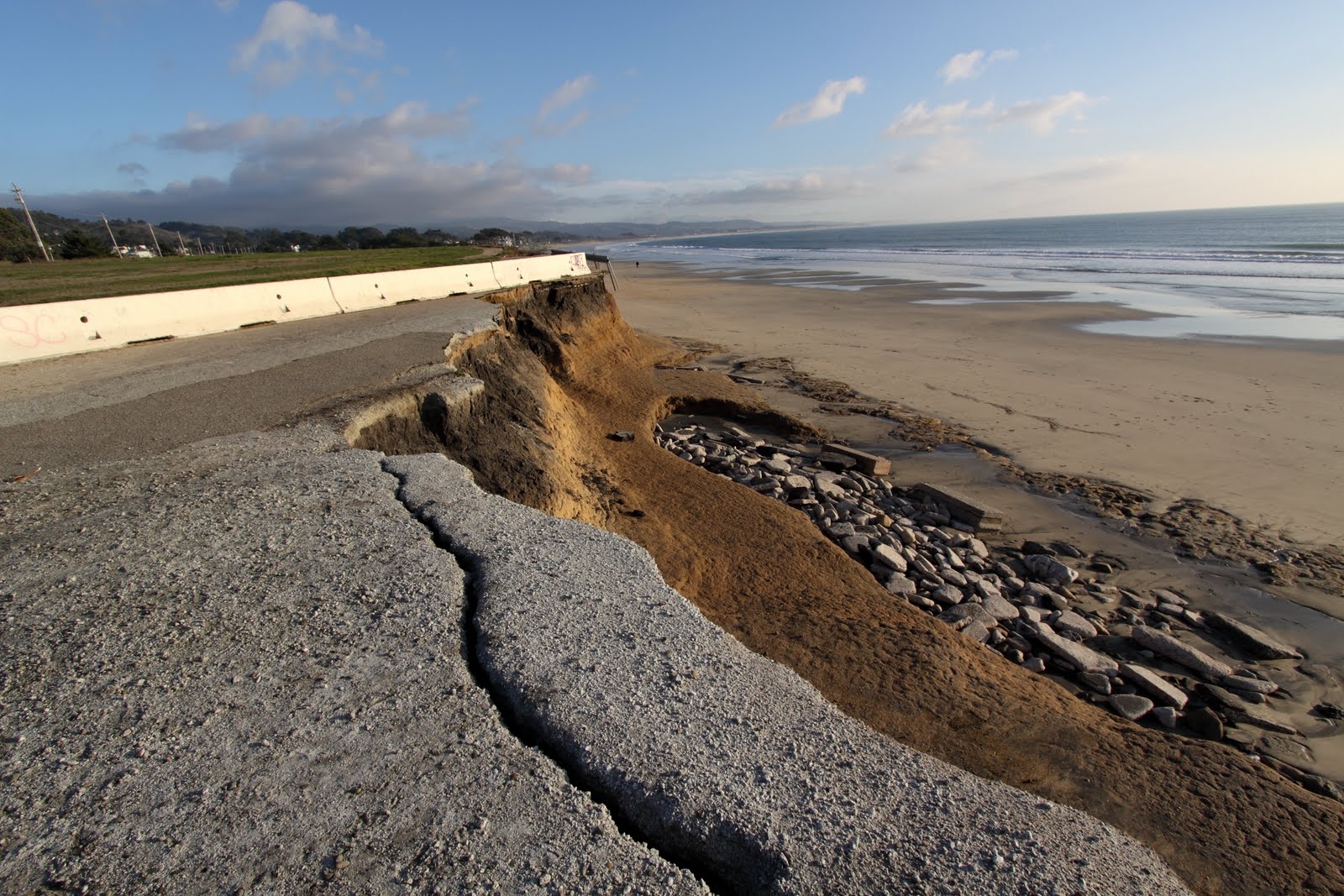
The Search for Solutions to Erosion Issues at Surfer's Beach

Photo of Surfer's Beach by Brian Overfelt
Efforts continue to find solutions to protect Surfer's Beach in Half Moon Bay, California. The construction of a breakwater to create the harbor in 1961 has exacerbated erosion rates by causing more sand to be deposited on the harbor side. Now only a thin strip of beach remains at Surfer’s Beach, limiting recreational uses of the beach, threatening habitat for the federally threatened western snowy plover, and eroding away the embankment of Highway 1.
Several possible solutions have been looked at, including building an artificial reef, poking a hole in the breakwater to see if circulation could be restored, building a small structure to trap sand and hall it away, and dredging. In order to discover whether any of these options would actually help the problem, the U.S. Army Corps of Engineers have first planned a study that takes into account all the factors that are causing the erosion. The impacts of these possible solutions have also yet to be assessed.
To establish baseline conditions for this study, the engineers partnered with the U.S. Geological Survey to disperse tide gauges and buoys to collect information about the wind, waves, and water to help them understand the problem and how to solve it. The Corps of Engineers, in partnership with San Mateo County Harbor district, presented these baseline conditions at a recent public meeting on June 6, 2011 in order to gain local community and general public input on the problem.
The engineers will spend the summer analyzing data and calibrating a model of Surfer’s Beach, and then later this year will propose alternatives for the beach to the community.
Friday, May 13, 2011
Thursday, May 5, 2011
Keep Following Us on Facebook
TO FIX THIS:
Scroll down to the bottom of the Newsfeed on your HOME page and click on "Edit Options". In the popup, click on the dropdown menu next to 'Show posts from:' and select "All Of Your Friends and Pages" and then click Save.
By doing this, you will receive newsfeeds from all your friends and pages. This will ensure that you will receive important updates about protecting coastlines and the ocean worldwide from Save The Waves.
Tuesday, May 3, 2011
Save Sloat!!!

The original Strategic Relocation vision from the Ocean Beach Task Force 2002: Courtesy of Brad Evans and Bob Battalio of Phillips Williams and Associates.
Information courtesy of Bill McLaughlin of Surfrider San Francisco
As has been done throughout the world, the City of San Francisco has been developed right up to the edge of the coastline in Ocean Beach. The bluffs have been eroding slowly over time, but early in 2010, much of California was battered by a series of powerful winter storms. Coastal erosion was widespread. At Ocean Beach, the area south of Sloat Boulevard was hit particularly hard. Up to 30 feet of sandy bluff washed away exposing large amounts of concrete debris. The southbound lane of the Great Highway was undermined and fell off the cliff onto the beach.
On January 15th a declaration of emergency was issued by the SF Department of Public Works (SFDPW) to protect City infrastructure in area. In addition to the Great Highway, a wastewater tunnel that runs underneath that road was thought to be in danger of being unearthed. Acting under emergency powers, the agency began construction of a 440 foot long wall of boulders (or rock revetment) to halt the erosion and to protect the tunnel and what remained of the road. Surfrider Foundation San Francisco Chapter and Save the Waves Coalition joined forces to oppose the revetment and have argued the need for a more sustainable long-term plan.
So now, engineers under the SPUR Master Plan and key city officials are beginning to form alternative long term plans for Sloat Erosion. The next public workshop which will offer citizens an opportunity to weigh in on this issue will be June 4. Location TBA. In the meantime Surfrider San Francisco would like to begin a deeper discussion of our preferred plan: Strategic Relocation (also known as Managed Retreat). Below is a series of links in which Strategic Relocation was used to respond to coastal erosion events in California. These three examples involve public infrastructure that was being threatened by an encroaching high tide line, as well as the need to remove fill/rubble and add sand in its place. Note the 2 local projects. Successful examples of this strategy are found in our own backyard...
MAKING THE CASE FOR STRATEGIC RELOCATION (CLICK THE LINKS BELOW):
SURFER'S POINT - Ventura, Ca:
SURFER'S POINT (PWA PROJECT WEBSITE)
SURFER'S POINT (NOAA WEBSITE)
SURFER'S POINT (SURFRIDER WEBSITE)
SURFER'S POINT (VENTURA RIVER WEBSITE)
PACIFICA STATE BEACH (Lindamar) - Pacifica, Ca
PACIFICA STATE BEACH (PWA PROJECT WEBSITE)
CRISSY FIELD - San Francisco, Ca
CRISSY FIELD (PWA PROJECT WEBSITE)